Smart Sensor Placement Using Machine Learning and Bayes Risk for Structural Health Monitoring of Air Vehicles
An aircraft structural health monitoring framework that uses machine learning and Bayes risk to place strain sensors where they provide the most reliable evidence of damage.
Overview
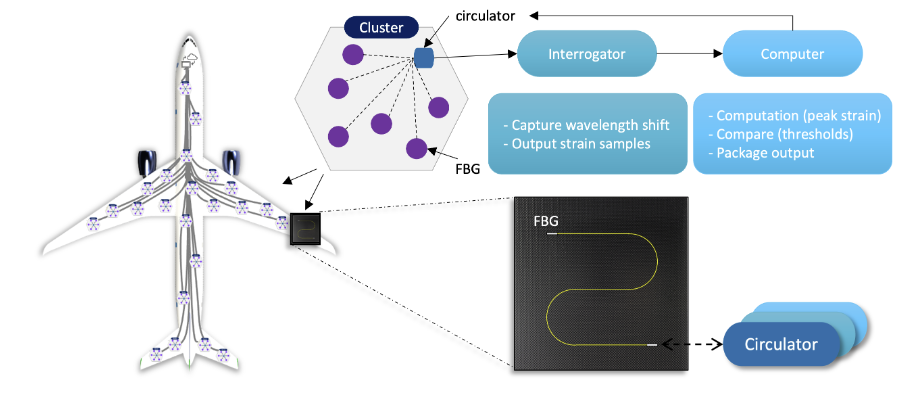
This work asks how a limited sensor network can monitor an air vehicle reliably across uncertain damage and operating conditions. It combines structural simulation, machine learning, and Bayes risk to identify sensor locations that are informative for damage detection and practical for deployment.
Approach
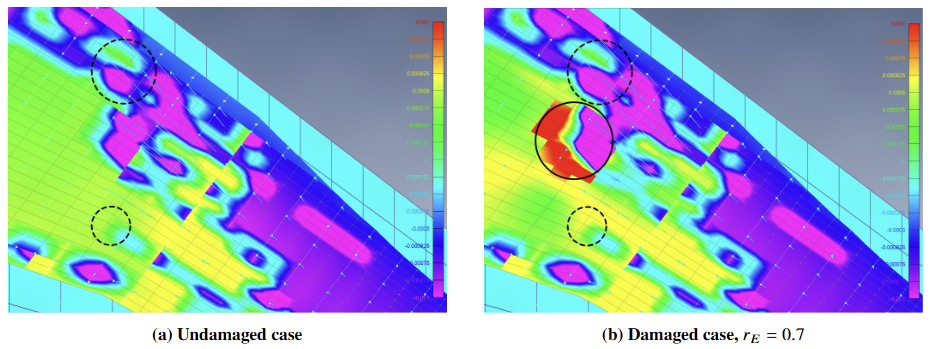
High fidelity finite element simulations generate strain responses for undamaged and damaged structures across multiple flight conditions. A machine learning model interprets candidate sensor measurements, while Bayes risk evaluates the expected consequences of missed and false detections to guide sensor placement.
Contribution
I researched how aircraft damage should be represented computationally, together with the loads and environmental conditions experienced by a Boeing 747 across different flight states. I then designed a script driven NX Nastran workflow that varied damage location, geometry, severity, and flight condition and ran the cases in batches. This gave Vanessa’s experiments a large, reliable dataset grounded in realistic aircraft loading and structural response.